



The Emerald Crucible: Tough, But Worth It
There is an old, weathered adage whispered in dive shops from Oregon up to British Columbia: If you can dive in the Pacific Northwest, you can dive anywhere on the planet.

Facebook
Pinterest
Threads
Email
Honestly, given the sheer volume of rubber, steel, and lead we strap to our bodies just to achieve neutral buoyancy, you could probably add “any other water-bearing planet in the solar system” to that claim. While a tropical diver steps off a boat wearing a smile and two tiny blocks of lead, a local cold-water diver gears up looking like an armored tank, carrying enough metal to anchor a small skiff. If you accidentally fall off the dock out here before inflating your wing, you aren’t diving; you’re a structural pile.
To the uninitiated—those whose dive logs consist entirely of bath-warm water, visibility measured in football fields, and swimwear—our local waters look intimidating. They aren’t entirely wrong. It is cold, it is dark, and the physical demands are real. On a “good day,” visibility might mean you can actually see your own fins, while a bad day feels like playing hide-and-seek with your buddy inside a giant bowl of cold pea soup.
But if you are willing to look past the initial layer of green gloom, you will discover an ecosystem that rivals any tropical reef on Earth. We get to share the water with ethereal sea angels, prehistoric sixgill sharks, passing pods of orcas, wolf eels that look like muppets, and stunning sailfin sculpins. And, of course, the magnificent Giant Pacific Octopus (GPO), an animal so intelligent and massive it makes your average tropical reef fish look like a background extra.
But to earn these sights, you have to survive the crucible of the cold.
The Stealth Tax of the Cold: Narcosis, DCS, and the CO2 Trap
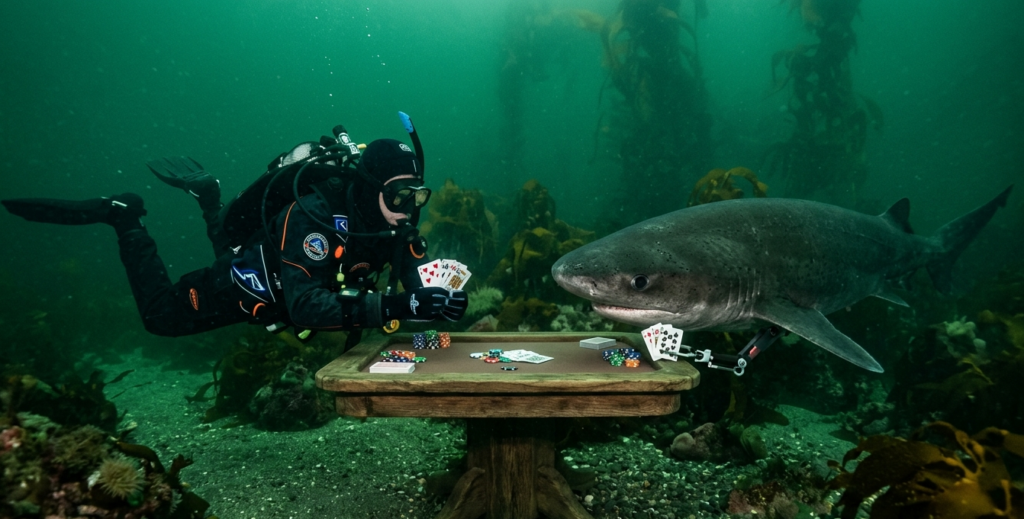
The obvious adversary here is temperature. Our water floats consistently in the mid-40s to low-50s Fahrenheit. Without proper thermal protection, your core temperature drops, your fine motor skills evaporate, and your decision-making turns to sludge. But there is a hidden physiological tax that cold water extracts: it accelerates nitrogen narcosis, spikes your work of breathing, and fundamentally alters your decompression risk.
Most divers associate “the narks” with a specific depth threshold—the classic “Martini’s Law” starting around 100 feet. In the PNW, that law gets heavily discounted. When your body fights to stay warm, peripheral vasoconstriction (the narrowing of blood vessels in your limbs to protect your core) increases central blood volume. Furthermore, cold gas is dense gas. Breathing dense gas at depth drastically increases your Work of Breathing (WOB). If you panic or overexert yourself, your body fails to efficiently clear carbon dioxide.
This results in CO2 retention, which acts as a massive amplifier for nitrogen narcosis. Combine that physiological stress with low visibility and the dark, eerie quiet of a deep emerald wall, and you have a vicious trinity of Cold, N2, and CO2 that can leave you feeling distinctly “loopy” or anxious at 70 feet instead of 100.
Worse yet, cold alters your circulation in a way that sets a perfect trap for Decompression Sickness (DCS). During the deep, working portion of your dive, you might still be relatively warm, meaning your tissues are well-perfused and absorbing inert gas at a standard rate. But as the dive progresses and the cold sinks into your bones, your body restricts peripheral blood flow to conserve heat.
By the time you ascend to make your safety or decompression stops, the very tissues that loaded up on nitrogen are now experiencing drastically reduced circulation. Your body’s ability to efficiently off-gas that nitrogen is severely compromised. Cold turns your circulatory system into a one-way street: easy to load gas, incredibly hard to clear it.
The Hardware Tax: Mechanical Demands of the Deep Green
Because the environment is unforgiving, your gear has to work twice as hard. In water this cold, standard warm-water regulators can fail catastrophically. The rapid drop in pressure as gas passes through your first stage causes a massive drop in temperature. If your regulator isn’t an environmentally sealed, cold-rated piece of machinery, moisture from your breath or the surrounding water can freeze the internal components solid.
The result? A sudden, catastrophic freeflow that turns your regulator into a roaring underwater leaf blower, dumping your gas supply in minutes. Dealing with a freeflow at 90 feet in green water requires calm, practiced muscle memory—not a panicked sprint to the surface.
The Dry Suit Dilemma: Anatomical Realities and the Hydration Crisis
To combat this thermal tax, most serious PNW divers eventually make the leap to a drysuit. It’s a wonderful piece of engineering that keeps you perfectly dry—or it’s supposed to—right up until it introduces a psychological trap unique to cold-water diving: voluntary dehydration.
The logic, though fatally flawed, goes like this: “If I drink water, I will have to pee. If I have to pee, I have to navigate a grueling, multi-layer extraction process in the freezing wind on a rocking boat just to strip down and relieve myself. Therefore, I will simply choose not to consume liquids today.”

As a matter of clinical fact, thick, sluggish, dehydrated blood is an absolute playground for DCS. When your blood volume drops, circulation slows, and the bubble-clearing mechanisms of your lungs are severely impaired. Furthermore, dehydration compounding with cold immersion significantly spikes your susceptibility to narcosis. If you are skipping the water bottle to save yourself a trip to the head, you are actively inviting the bendy spirits into your dive profile.
So, how do we solve the elimination problem without “bending” ourselves?
For male divers, the go-to solution is an external catheter paired with a balanced P-valve (or “relief valve”) installed in the thigh of the suit. It’s a simple mechanical solution. For female divers, however, the plumbing is significantly more complicated. The external collection systems designed for female anatomy require precise placement, specialized adhesives, and a frustratingly high degree of trial and error to prevent catastrophic, suit-flooding leaks.
Because of those anatomical hurdles, many divers—regardless of gender—opt for the low-tech, zero-failure-point alternative: the adult diaper.
A diaper is a legitimate piece of life support gear!
~ Doc
Look, let’s strip away the pride for a second. There is zero shame in the diaper game. It requires a certain amount of psychological fortitude to transition from a “hardcore, technical underwater explorer” to “a person wearing a Pampers on a Saturday morning,” but they work flawlessly. They require no invasive plumbing or adhesive removal post-dive, and they completely eliminate the anxiety of hydration. If it keeps your blood volume up, your tissues flushing nitrogen correctly, and your core warm, a diaper is a legitimate piece of life support gear. Drink the water, manage the output, and keep your bloodstream clean.
And remember: the thermal threat doesn’t end when you unzip. Standing around on a windy boat deck or a rocky beach in a damp undergarment exposes you to rapid evaporative cooling. If you don’t strip down and get into dry clothes quickly, your core temperature will plummet faster on the surface than it did at depth.
Building the Toolkit: Training for the Terrain
So, what’s the solution? You don’t just wake up one day, throw on a mountain of lead and a thick undergarment, and glide effortlessly through a kelp forest. It takes specialized education to turn these hazards into managed variables. If you want to transform from a surviving diver to a thriving one in these waters, there are three distinct paths you should look into:
- SDI Dry Suit Diver: This isn’t just about learning how to zipper yourself in. It’s about mastering the art of using a completely secondary bubble of air for thermal management without letting it migrate to your boots and turning you into an upside-down human dive flag.
- SDI Night/Limited Visibility Diver: Around here, “limited visibility” isn’t a rare emergency; it’s a Tuesday. This course strips away the anxiety of the dark, teaching you torch communication, navigation, and the psychological comfort needed to treat a low-viz environment like a cozy living room.
- SDI Cold Water Diver: A fantastic, unlisted specialty designed specifically for those who learned to dive in the warm, clear waters of the tropics. It bridges the gap, teaching the physiological adjustments, heavy weighting, and environmental awareness unique to colder climates. You’ll need to check with your local, amazing SDI instructor on this one!
The Ultimate Payoff
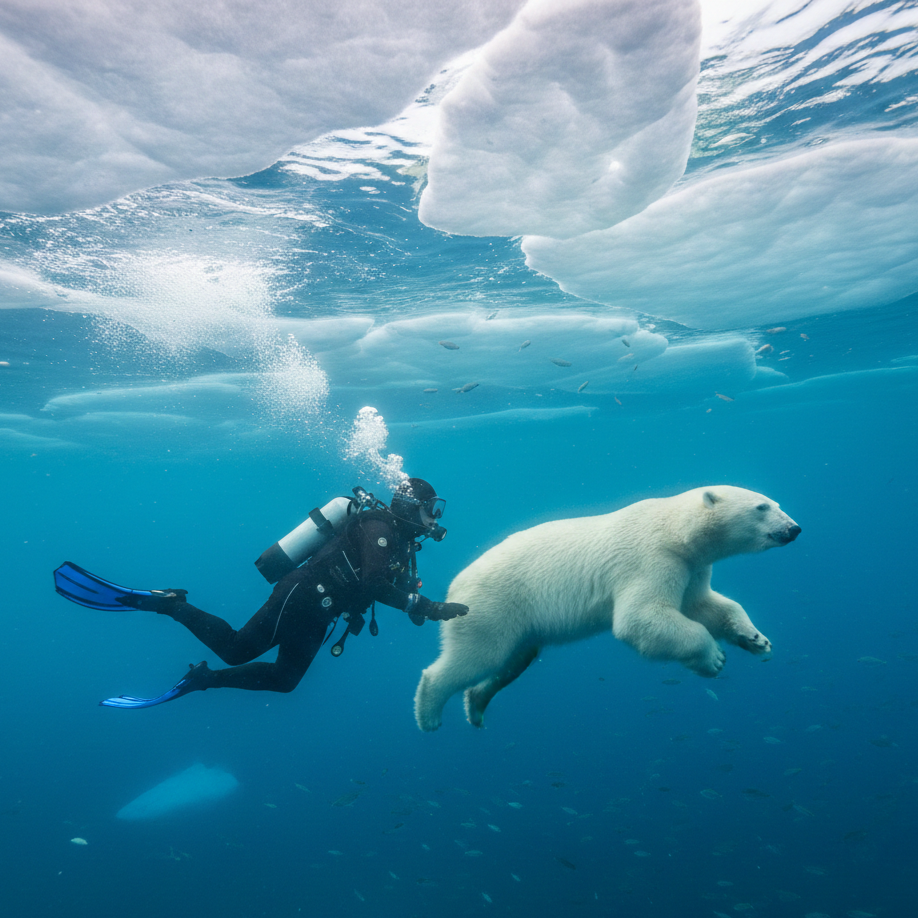
When you finally dial it in—when your buoyancy is locked, your drysuit is a second skin, and your mind is steady in the emerald twilight—something magical happens. You realize that the weight, the darkness, and the cold have forged you into an incredibly precise, resilient diver.
You become completely unflappable. If an emergency occurs in 80 feet of clear, 82°F Caribbean water while you’re wearing a 3mm shorty, it feels like an absolute walk in the park because your baseline training happened in a high-task-load, low-visibility environment.
We dive the Pacific Northwest because the challenge is real, but the rewards are spectacular. It takes grit, proper training, and an unyielding respect for physics and physiology. But once you conquer the cold, the entire planet is yours to explore.
See you down there!
~ Doc



Dr Eric "Doc" Strand, PhD, OMD
Dr. Eric "Doc" Strand (USMC Veteran) spent 30 years as a physician dedicated to community wellness. Recently retired after 30 years of clinical practice, Doc now spends his time enjoying the profound stillness and weightless silence of the underwater world. As an SDI Instructor Trainer, Dr. Strand uses his medical and military background to inform his writing on safety, physiology, and technical diving. A published author of medical practice management guides and poetry, Doc pairs his technical expertise with a creative flair to make complex diving topics accessible, engaging, and insightful.
Dr. Strand, owner and Chief Spartan of Spartan SCUBA in Gresham, Oregon, is also an active emergency response member of the Clark County Search & Recovery Dive Team, an instructor for both the Multnomah County and Clark County SAR teams, and is the Dive Safety Officer for the Maritime Archaeological Society, headquartered in Astoria, Oregon.
More from Doc
Tagged Cold Water Diving, SCUBA Safety