


The Illusion of “Clear”
The Illusion of "Clear": Why Your Dive Computer is a Calculator, Not a Crystal Ball
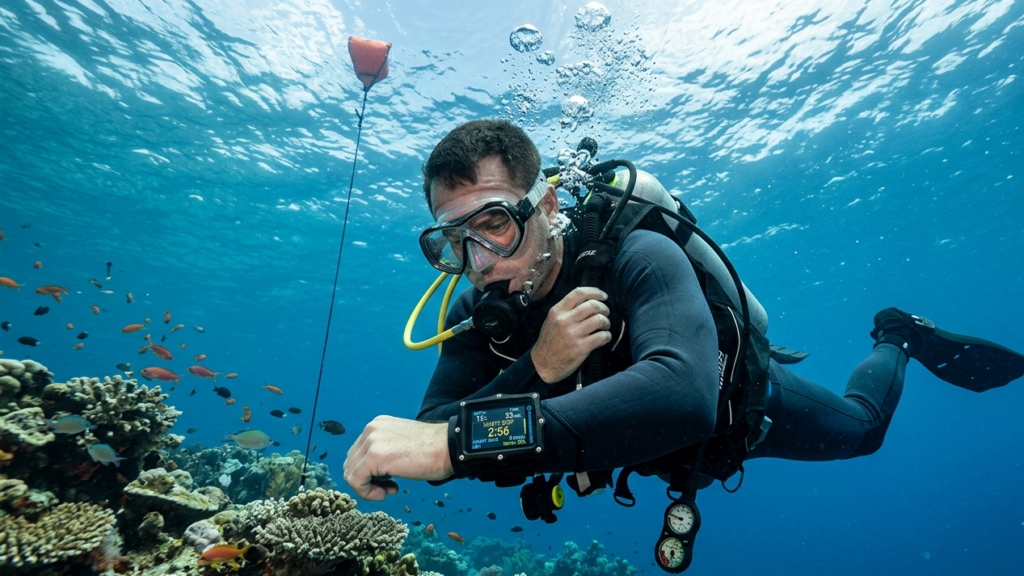
Every open-water student learns the rule like it’s handed down from Mount Sinai: thou shalt perform a three-to-five minute safety stop at fifteen feet. It’s a rite of passage. We hang on the line, watch our pressure gauges, and stare blankly at our buddies while waiting out the clock.
But a funny thing happens when we cross the threshold into the technical or advanced world. We buy sophisticated Personal Dive Computers (PDCs), learn about gradient factors, and watch our screens track multiple theoretical tissue compartments. Suddenly, we feel like masters of our own decompression destiny. When the PDC screen clears and the device tells us we are good to ascend, we take it as gospel. We are “clear.” Time to get out, right?
Well, hold your horses. It turns out that while your computer is an exceptional piece of engineering, it’s fundamentally a calculator—not a crystal ball. And your body is a complex, squishy meat sack, not a neatly organized spreadsheet.
The Day DAN Scanned the Bloodstream
To understand why “clear” might not actually mean “clean,” we have to look back at a monumental, foundational series of studies conducted by Dr. Alessandro Marroni and the DAN Europe research team.
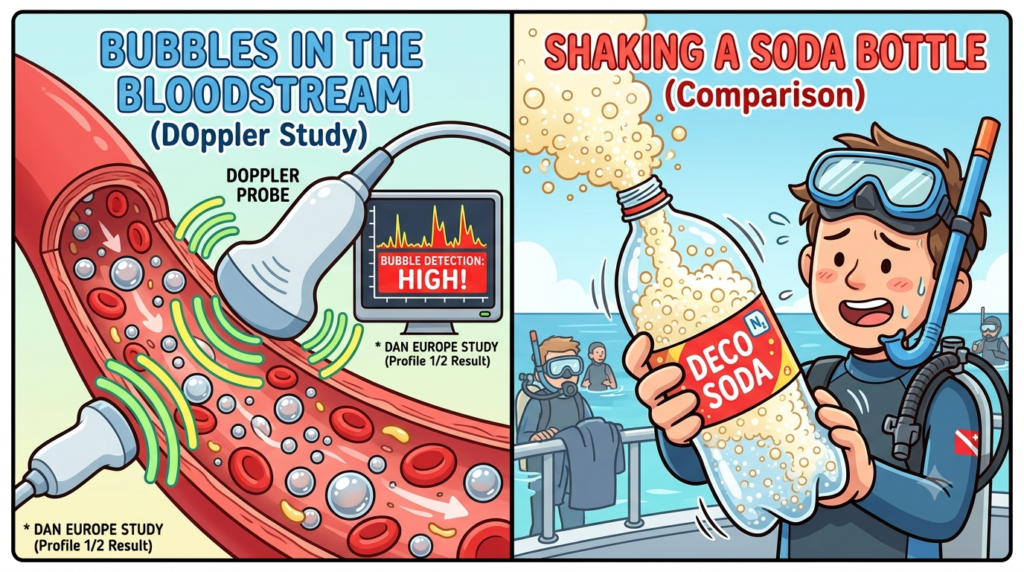
The researchers wanted to look past the pure mathematics of decompression algorithms and peer directly into actual human physiology. They took a group of divers, put them through a standard profile of 82 feet (25 meters) for 25 minutes, and used precordial Doppler ultrasound to physically listen for “silent bubbles” (vascular gas emboli) bouncing around the heart and bloodstream post-dive.
They tested 15 different ascent variations, but three specific profiles tell a remarkable story:
- Profile 1 (The Direct Ascent): Divers ascended linearly at 33 feet per minute directly to the surface with absolutely no stops.
- The Result: A massive, sustained spike in bubble formation that peaked within 15 to 30 minutes of surfacing and continued to fizz away for hours.
- Profile 2 (The Conventional Safety Stop): Divers ascended at the same rate but performed a standard 5-minute safety stop at 20 feet (6 meters).
- The Result: Considerably better than skipping it entirely, but the Doppler still recorded significant bubble scores back on the boat.
- Profile 3 (The Deep-to-Shallow Combo): Divers ascended at 33 feet per minute, did a 2.5-minute deep stop at 50 feet (15 meters), and then moved up to do a 5-minute shallow stop at 20 feet (6 meters).
- The Result: Mind-boggling. This specific profile yielded the lowest bubble scores of the entire study, effectively clearing out or entirely minimizing measurable microbubbles within 45 to 90 minutes of surfacing.
The Plot Twist: The researchers also tried a 1-minute deep stop. Guess what? Bubble scores actually skyrocketed. Why? Because 1 minute wasn’t long enough to halt the growth of existing bubble seeds, but it was long enough to continue loading the body’s slower tissues with inert gas. Context and precise timing are everything.
Dissolved Gas vs. The Shaken Soda Bottle
What Dr. Marroni proved is that your dive computer and your actual circulatory system are playing two different sports.
Your PDC utilizes mathematical models (like Bühlmann ZHL-16C) to track dissolved gas tracking in theoretical tissue compartments. When your computer says you have cleared your ceiling, it simply means that the math predicts your leading tissue compartment has dropped below its maximum allowable supersaturation limit (the M-value).
The computer assumes that gas leaves your body the exact same way it came in: seamlessly dissolved in your blood. What it doesn’t know is whether that gas has already phase-shifted into thousands of tiny micronuclei—the bubble seeds that turn your venous system into a freshly shaken bottle of soda.
If you are only doing one casual dive on a tropical vacation, a minor bubble spike probably won’t kick your butt too badly. But if you are doing what our instructors love to tout—really “diving your computer” across multiple days or aggressive repetitive profiles—you run the very real risk of stacking new bubble formation directly on top of old bubble formation.
The Technical Dilemma: To Stop or Not to Stop?
This brings us to the sharp end of the spear: what do we do on complex or decompression dives when the computer says we are totally in the clear?
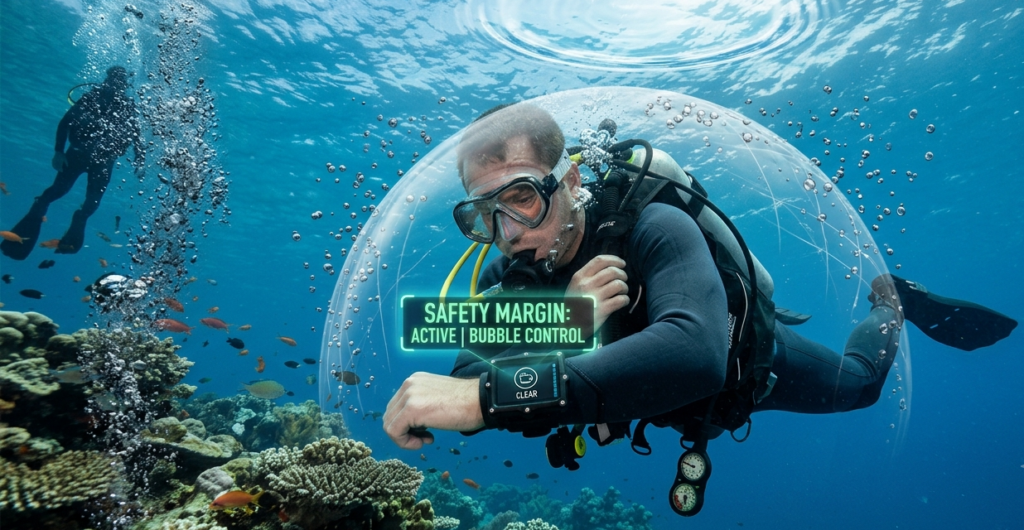
If environmental conditions permit, adding a “bonus” 3-to-5 minute safety margin at 15 feet after your required decompression schedule has wrapped up is incredibly cheap biological insurance.
Consider the physics. The final 15 feet to the surface is the most volatile zone in the entire water column because it represents the sharpest relative pressure change. Moving from 15 feet to the surface is a 1.5x drop in ambient pressure. Giving your absolute fastest, most critical tissues (like your blood and spinal cord) an extra window to off-gas under less gradient stress before subjecting them to that final, massive pressure drop is just good sense.
And here is a critical operational rule for when you are hanging out on that extra safety buffer: Never switch back to a lean bottom gas.
If you are running open-circuit nitrox/oxygen deco mixes or managing a rebreather setpoint, stay on that rich mix until your mask breaks the surface. Dropping back to a standard 21% mix drops your partial pressure of oxygen shrinks your “oxygen window,” and dramatically slows down your off-gassing efficiency right at the most critical depth. Stay on the high gas, keep the gradient working in your favor, and let those microbubbles clear.
The Bottom Line
Unless you are dealing with a genuine emergency—low gas, a dragging anchor, a shifting current, or an impending environmental hazard—turning a blind eye to the safety stop just because your computer screen says 0 min is an unnecessary gamble.
Your computer is an indispensable tool, but it doesn’t have an ultrasound probe strapped to your chest. Respect the math, but defend the physiology. Your squishy meat sack will thank you for it!
References & Further Reading
- The Foundational Study: Marroni, A., Bennett, P. B., Cronjè, F. J., et al. (2004). A deep stop during decompression from 82 fsw (25 m) significantly reduces bubbles and fast tissue gas tensions. Undersea & Hyperbaric Medicine, 31(2), 233-243. PubMed ID: 15485086
- The Follow-Up on Timing: Marroni, A., et al. (2007). Effect of varying deep stop times and shallow stop times on precordial bubbles after dives to 25 msw (82 fsw). Undersea & Hyperbaric Medicine, 34(6), 399-406. ResearchGate Citation


Dr Eric "Doc" Strand, PhD, OMD
Dr. Eric "Doc" Strand (USMC Veteran) spent 30 years as a physician dedicated to community wellness. Recently retired after 30 years of clinical practice, Doc now spends his time enjoying the profound stillness and weightless silence of the underwater world. As an SDI Instructor Trainer, Dr. Strand uses his medical and military background to inform his writing on safety, physiology, and technical diving. A published author of medical practice management guides and poetry, Doc pairs his technical expertise with a creative flair to make complex diving topics accessible, engaging, and insightful.
Dr. Strand, owner and Chief Spartan of Spartan SCUBA in Gresham, Oregon, is also an active emergency response member of the Clark County Search & Recovery Dive Team, an instructor for both the Multnomah County and Clark County SAR teams, and is the Dive Safety Officer for the Maritime Archaeological Society, headquartered in Astoria, Oregon.
More from Doc


Tagged safety